Mike Rijnierse is an artist, inventor, curator and educator sculpting time through light and sound into spatial experience. Intrigued by our sensory structures, Rijnierse composes with and for the environment, creating spatial dialogues. His work has been exhibited throughout Europe, Korea, Taiwan, Morocco, United Arab Emirates and Brazil, in contexts such as media art festivals, museums, galleries, sculpture gardens and urban spaces.
As a docent Design Art Technology at ArtEZ University of the Arts – Arnhem, since 2009, Rijnierse has devised the course Inventing Instruments, where students research and create instruments that transcend technological domains, exploring new and imaginary media.
“The poet’s task is to extend the images a little to be sure that the human quality of the mind is operating in them, to be sure that they are human images, images that humanize the forces of the cosmos. Then we are led to a cosmology of what is human. Instead of experiencing a naive anthropomorphism, we turn man over to elemental and deeply rooted forces.”
– Gaston Bachelard – ‘Air and Dreams, an essay on the imagination of movement’
LIGHT SCULPTURES
Over two decades, Rijnierse has developed a meticulous study on the interaction between light and the retina. He gave concrete form to his discoveries through the series of light installations CYMRGB (2001- …. ). These works can be described as optical music or opto-acoustics, by animating colored surfaces in time with composed light projections. His work Lumokinese (2008) has been widely exhibited since 2008 and most notably been presented along masterpieces by László Moholy-Nagy, Dan Flavin, Adam Barker-Mill, Gianni Colombo and others, at Van Abbemuseum in Eindhoven (NL) in 2016.
Drawing knowledge from optics and studying early devices such as the Lanterna magica, kaleidoscopes and zootropes – precursors of film, animation and digital media – Mike Rijnierse is not guided by nostalgia, his interest is in questioning the current production of image and examining visual perception. Current devices and instruments at our reach today no longer show their process and therefore they work as ‘black boxes’. By opening up and sharing the process of light / color production, source and shadow, the artist illustrates how illusion and vision are intertwined.
Halo (2019) is a light sculpture that manifests itself in the sky as an atmospheric light phenomenon. The interaction between projected light in relation to the atmospheric constellation determines this ephemeral light sculpture. Halo is a sculpture that exists by interacting with the elements in the present. It explores the relation between atmospheric optics and the human perspective. Looking at a light projection into the sky, cast by passing hydro-meteors, a circular prism is shaped in the atmosphere.
Another of his light sculptures, Cube (2015) operates on the principle of multiple reflections inside the kaleidoscope. It displays several mirrors at perpendicular angles, forming a cube that is lit from inside. In contrast to the classical kaleidoscope, where light enters the object, Cube embodies light from within and projects its multiplication outwards into the space. Cube is choreographed by an autonomic algorithm that directs the synergy between light and sound, developed in collaboration with artist Rob Bothof.
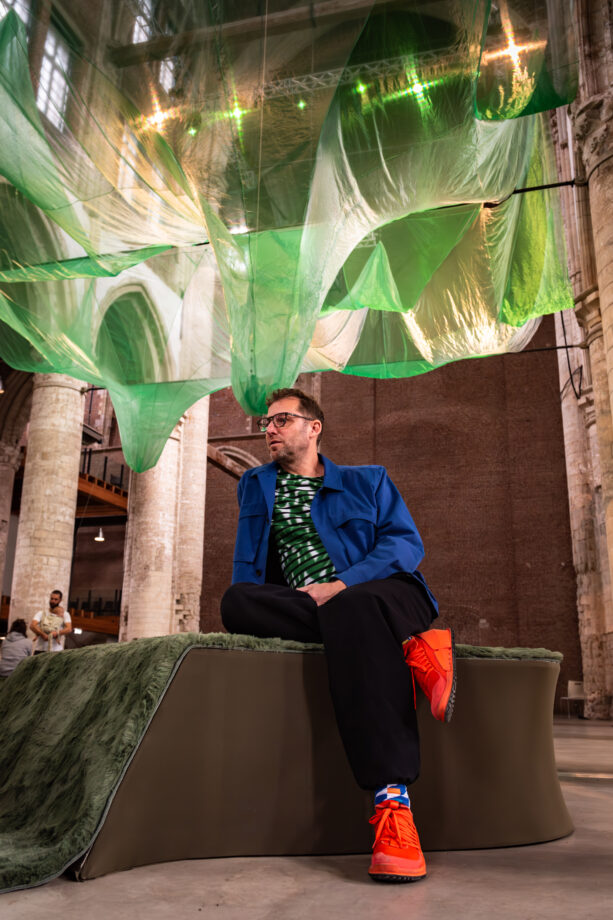
Recently, in collaboration with Ludmila Rodrigues, he has developed the work Sunset, a light monument for urban spaces, which has been shown in Delft (2021), in The Hague (2022), in Paris (2023), in the Woods (2023 – 2024) and in Amsterdam (2025). The work explores our relationship with the phenomenon of the sunset – its captivating radiance and the subsequent image production. There latest creation Buoyants is on show until May 2026.
Volver (2021) is a light sculpture that reflects itself into infinity. A light source situated at the bottom of a cylindrical mirror bounces around by the rotation of two other smaller mirrors, drawing an ever evolving light image on a round surface of 1,5 m diameter. This continuous process of reflection offers the impression of a portal, as if the projected surface had an undefined depth. While the light is modulated by revolving mirrors controlled by a generative algorithm, the reflections will never repeat themselves.
Quantum Mirror (2024) is a sculpture that brings the concept of quantum states to life through the gaze of two observers. The design of the double-sided mirror is generated by an algorithm based on wave function collapse, a mathematical model describing quantum superposition. When two viewers stand opposite each other, their simultaneous observation briefly merges into a single image, symbolizing the concept of superposition in quantum physics—the idea that subatomic particles can exist in multiple states simultaneously until observed, at which point the superposition collapses. The work was created by artist and media researcher Mike Rijnierse, with the algorithm developed by creative coder Rob Bothof. Each edition of Quantum Mirror features a unique, algorithmically generated pattern.
Interference #001 (2025) is a light sculpture composed of a grid that interferes with its own reflection. The image that emerges is defined by the viewer’s position. Through the subtle interplay of material, shadow, reflection, and perspective, the work engages in a continuous dialogue with its audience. The work is not an image, but a system of interrelated elements. The composition derives its meaning from the interplay between these elements and the viewer’s perspective. There is no separate “subject” that exists independently of the form; in its radical minimalism, the work leaves space for interpretation to arise entirely from what the viewer brings to it. Meaning does not exist prior to observation. Like a quantum state, multiple potential readings coexist simultaneously, until the act of observation collapses them into a singular experience.
SOUND SCULPTURES
As a selected artist of SHAPE 2017, Mike Rijnierse premiered the sound sculpture Relief at festival Novas Frequências in Rio de Janeiro (BR). Relief, developed in collaboration with Rob Bothof, is an installation that utilizes ultrasound to explore the notion of echolocation. The work examines the process of hearing, decomposing reflections of the space which inform orientation, emphasizing the relationship between source and receiver. Relief is therefore an echosculpture.
Rijnierse’s sonic sculptures Klok (2015), Relief (2016), Soundman (2017), Piano / Forte (2018), Adaptation #1 (2019), Sino (2021) and Ostraka (2023) explore the acoustic domain. In fact, the phenomenon of echo and reflection is a recurring theme in the work of Mike Rijnierse. As architect Juhani Pallasmaa wrote in ‘The Eyes of the Skin’: “Sight isolates, whereas sound incorporates; vision is directional, sound is omni-directional. The sense of sight implies exteriority, whereas sound creates an experience of interiority. I regard an object, but sound approaches me; the eye reaches, but the ear receives. Buildings do not react to our gaze, but they do return our sound back to our ears.”
Another facet of Rijnierse’s work are interventions in public space. The artist created THX: INT’L (landing strip) for TodaysArt festival 2007. Turning the city of The Hague into an International Airport. The Grote Markstraat – 600 meters long – was transformed into a landingstrip, using 36×6 indivual controllable lights and 48 2000-Watt speakers, Creating the experience of airplanes landing in the main street of the city of The Hague. The landingstrip connected the two main areas of the festival, with a total of 25 stages throughout the city. The Volharding building functioned as an arrivals & departures sign, all tied together by audio-announcements of ‘incoming’ artists in eight different languages.
For TodaysArt’s 2008 edition, Rijnierse initiated and created Station to Station, in collaboration with Staalplaat Soundsystem and Erik Hobijn. In this project the entire railway station of The Hague Central – including its building, trains, trams and passersby – became part for a large scale site specific sound art intervention, with the timetables of the trains and trams serving as the departure point for the composition. The train tracks were interpreted as faders of a sound mixing desk, while the train station operated its daily schedule.
For TodaysArt 2015 Mike Rijnierse presented two works: Klok , a 100kg church bell that was thrown down, every hour from the bungee jump tower of the Pier of Scheveningen. The 60 meters free fall of the bell added a Doppler effect to its tolling sound. The second work, 5,4,3,2,1…Lift-Off, performed in the opening of the festival, simulated the launching of a space rocket, where Rijnierse deployed a monumental amount of light, sound, smoke and pyrotechnics, in coordination with a pool of experts to yield the visceral sensation of a rocket launch. In essence, the two works, Klok and 5,4,3,2,1…Lift-Off, complement one another as vertical gestures, while the Doppler effect was represented in both a fall and a colossal lift-off.
Besides individual projects, Mike Rijnierse has collaborated in a wide range of disciplines and theater collectives, such as Rosa Ensemble and GöteborgsOperan.
Interview by Régine Debatty (we-make-money-not-art)
Interview by Lucia Udvardyova, SHAPE
ArchiNed on Locating ArtScience